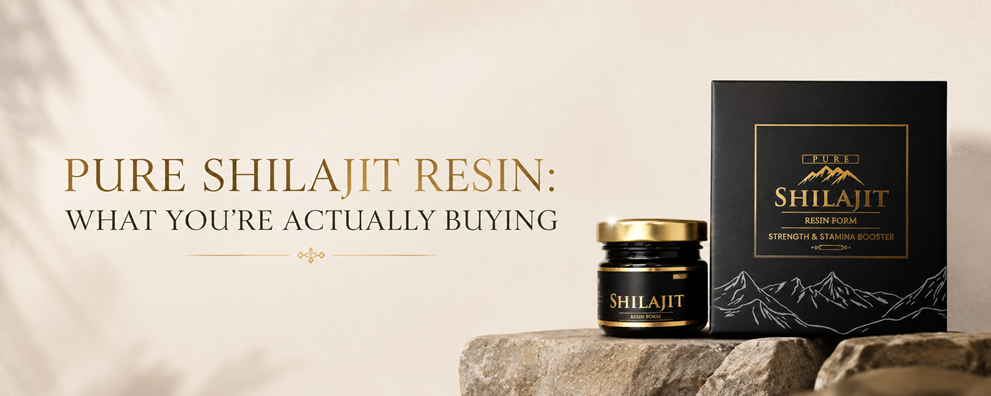
You paid good money for a small jar of something tar like and sticky, and now you’re staring at it wondering if you got real Shilajit, or a jar of purified soil with a nice label on it. That worry is fair. It’s more common than most brands would like to admit.
Shilajit has quietly become one of the most searched natural supplements in India, and along with the demand has come a flood of products that look the part but aren’t tested for what actually matters.
The Shilajit You Bought Might Not Be Shilajit
Here’s the uncomfortable truth. Shilajit forms naturally over centuries in high altitude mountain rock, which means it can absorb whatever was in that rock, including heavy metals like lead, arsenic, and cadmium, along with the minerals people actually want.
A genuine, well purified resin removes those risks. A cheap, untested one doesn’t, no matter how convincing the packaging looks. And you genuinely can’t tell the difference by taste, smell, or texture alone.
Why Purity Is Suddenly Such A Big Deal
This isn’t a small niche concern anymore. Global search interest in Shilajit grew by more than 130% between 2022 and 2024, and the global market is on track to cross $105 million by 2029. Demand exploded faster than quality control did, and independent testing has been catching up ever since.
| What testing has found | Why it matters |
|---|---|
| A 2025 study found unsafe thallium levels in some imported samples | Thallium builds up in bone tissue over years of exposure |
| Fulvic acid content, the main active compound, varies widely and is rarely listed on labels | Genuine Himalayan resin typically runs 60 to 80% fulvic acid, below 50% suggests dilution |
| Third party lab testing, not home solubility tests, is the only reliable check | Home tests only catch obvious fakes, not trace heavy metals |
| The realistic 2026 price floor for properly lab tested resin sits around ₹1,500 for 20g | Proper thallium and heavy metal screening genuinely costs money to run |
None of that is meant to scare you off Shilajit. It’s meant to explain why the source and the manufacturing process matter far more than the price tag on the jar.
What Real Resin Form Shilajit Should Actually Do
Done right, Shilajit is one of the more genuinely useful things in an Ayurvedic routine. It’s traditionally used to support daily energy, build stamina and physical strength over time, speed up recovery after exertion, sharpen focus and mental clarity, and help the body absorb nutrients from food more efficiently.
Note the phrase “over time.” Like most Ayurvedic formulations, it’s not an instant energy shot. It’s a daily mineral rich support that builds gradually, which is exactly why consistency matters more than the size of the dose.
How Bhumia Ayurved’s Shilajit Is Made Different
Pure Shilajit in its resin form stays exactly that, resin, not a capsule padded with fillers to stretch out a batch. It’s manufactured through Pranacharya Bhawan Ayurvedic Sansthan in Aligarh, Uttar Pradesh, in its traditional form with no added chemicals.
That matters because capsule powders are one of the easiest places for a brand to cut corners, diluting the actual resin with bulking agents that do nothing for you. Staying in pure resin form removes that shortcut entirely.
At ₹1,149 for a 15g jar, it sits close to what genuine, properly sourced Himalayan resin actually costs to produce and test. If it feels expensive compared to a random jar online, that’s usually the gap between something real and something cut with filler.
How To Use It Without Wasting The Jar
Take a pea sized portion and dissolve it fully in lukewarm water or milk until it mixes through completely, once or twice a day. It shouldn’t leave gritty residue behind, real resin dissolves clean.
Store it somewhere cool and dry, away from direct heat, moisture, and sunlight. Don’t refrigerate it, and don’t leave the lid off for long stretches, exposure to air and moisture is what degrades resin fastest.
If you’re buying Shilajit, the actual takeaway is simple. Stop choosing by price alone, and start asking where it’s manufactured, whether it stays in resin form, and how it’s stored before it reaches you. That’s the real difference between a jar that does something and a jar that just sits in your cupboard. You can see the full sourcing and usage details on the Pure Shilajit product page, or browse Bhumia Ayurved’s other formulations if liver health or blood sugar support is also on your list.
Have you ever bought Shilajit and genuinely wondered if it was the real thing? What made you trust it, or made you return it? Tell us in the comments below.